NEWS, CASE STUDY
Dynamic Bridge Monitoring in Chile – First Field Experience with the RIEGL VZ-600i Profile Scanning Mode at Puente Las Cucharas
The monitoring of civil engineering structures has become an essential component of modern maintenance and risk management strategies. Structural Health Monitoring (SHM) is used here as a decision-support tool by evaluating the actual structural behavior under operational conditions. At the “Puente Las Cucharas” railway bridge in Chile, a team led by Prof. Daniel Czerwonka-Schröder from the Department of Geodesy at Bochum University of Applied Sciences, put dynamic monitoring using terrestrial laser scanning to the test in a real-world application. The RIEGL VZ-600i was used in line-scan mode to gather initial field experience regarding practical implementation, data acquisition strategies, and operational performance during regular railroad operations.

Recent developments in terrestrial laser scanning (TLS) technology enable measurements with unprecedented temporal resolution and expand its range of applications from traditional static surveying to the dynamic monitoring of civil engineering structures. A key innovation is the profile scan mode of the RIEGL VZ-600i terrestrial laser scanner, which enables the continuous acquisition of a single scan line at a rate of up to 420 profiles per second. This high-frequency operation opens up new possibilities for the noncontact observation of vibrations, transient deformations, and other short-term structural phenomena.
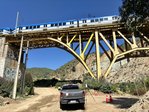
In September 2025, this feature was tested for the first time under real-world operating conditions as part of a field trial on the Puente Las Cucharas railway bridge of the Metro Valparaíso, Chile (officially EFE Valparaíso, S.A.). The objective was to evaluate the performance, stability, and practical usability of the profile scanning mode in a complex outdoor environment. During regular train crossings, continuous profile sequences were recorded over several minutes, capturing the bridge under realistic dynamic loads.

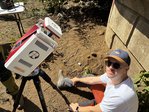
The experimental setup included synchronized triggering, reference scans, and a stable instrument mounting to ensure geometric consistency and precise temporal control. The acquired datasets allow for an initial assessment of the achievable measurement precision, signal stability, and data completeness under dynamic conditions.
Initial results show that the system delivers stable, dense, and geometrically consistent measurement data even under varying environmental and motion conditions. This paper describes the experimental setup, the data acquisition strategy, and the initial technical observations from field deployment in Chile. The results highlight the potential of the profile scan mode as a valuable extension of existing monitoring concepts and as a complement to established sensor-based methods such as accelerometers, GNSS, or fiber-optic measurement systems.

The fieldwork was supported by Claudio Avello and David Santos from the RIEGL South America team. Aside from the technical details that the team covered in their scientific papers, Claudio Avello, Managing Director of RIEGL South America Spa., provided us with some background information on the project site:
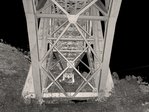
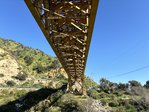
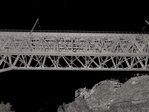
This project in Las Cucharas (“The Spoons”) is particularly interesting because it involves a railroad bridge that was opened as early as 1913 as part of the expansion of Chile’s national railroad infrastructure to connect Santiago and Valparaíso. The first railroad bridge in this area—a much simpler structure—dates back to 1856. Following the 1906 earthquake, it was replaced by the current bridge between 1908 and 1913 as part of a comprehensive modernization project to increase the capacity of the rail line. The steel superstructure, approximately 145 m long and 7.5 m wide, was manufactured in France by the French company Schneider et Cie (Le Creusot), shipped to Chile, and still stands today as a testament to the high level of expertise in French engineering and manufacturing.
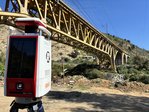
Explore some impressive photos and data from the scene:

This article is based on the publication of
Prof. Dr.-Ing. Daniel Czerwonka-Schröder from the Department of Geodesy at Bochum University of Applied Sciences
Dr. Florian Pöppl, Head of Software Development at RIEGL Laser Measurement Systems
Prof. Dr.-Ing. Sebastian Fingerhuth, School of Electrical Engineering at the Pontifical Catholic University of Valparaiso
which have been published in course of the 21st International Engineering Surveying Course in February 2026 at the Graz University of Technology (paper in German), as well as the follow-up publication in May 2026 as part of the XXVIII FIG Congress 2026 in Cape Town (paper in English in the corresponding congress proceedings).


